Published
- 7 min read
How Supply Chain Attacks Evolved: The Developer Credential Economy

On April 13, 2026, an infostealer scraped a Red Hat employee’s GitHub session cookie. For exactly seven weeks, that stolen credential sat dormant in a dark web marketplace.
Then, on June 1, it was weaponized. Attackers used it to poison 32 official packages under the @redhat-cloud-services npm namespace, unleashing the self-propagating Miasma worm onto 117,000 developer machines. Within five days, the campaign breached Microsoft Azure repositories, bypassed SLSA Build Level 3 attestations, and introduced a terrifying new persistence mechanism: targeting local AI coding assistants.
We are no longer fighting the SolarWinds playbook. Supply chain attacks have industrialized.
The threat model has shifted from isolated package compromises to an interconnected Developer Credential Economy. Here is a technical breakdown of how supply chain tradecraft has evolved in 2026, why your EDR is completely blind to it, and the Continuous Threat Exposure Management (CTEM) playbook required to stop it.
What to Remember
- The Developer Credential Economy: Supply chain attacks now operate in a three-layer economy: Generation (harvesting secrets), Distribution (dark web brokers), and Weaponization (cascading compromise).
- SLSA is Not a Silver Bullet: Miasma produced malicious packages with valid SLSA Build Level 3 provenance, proving that cryptographically signing a poisoned CI/CD pipeline just creates signed malware.
- AI Agents are the New Attack Surface: Attackers are dropping malicious configuration files (
.cursor/rules,.claude/settings.json) to silently backdoor AI coding assistants on developer laptops. - EDR is Blind to CI/CD: Endpoint detection monitors execution, not exposure. It cannot see ephemeral GitHub Actions runners where the actual credential theft occurs.
- Human-Gated Publishing is Mandatory: You must break the automation chain. Enforce staged publishing and minimum release age controls to stop self-propagating worms.
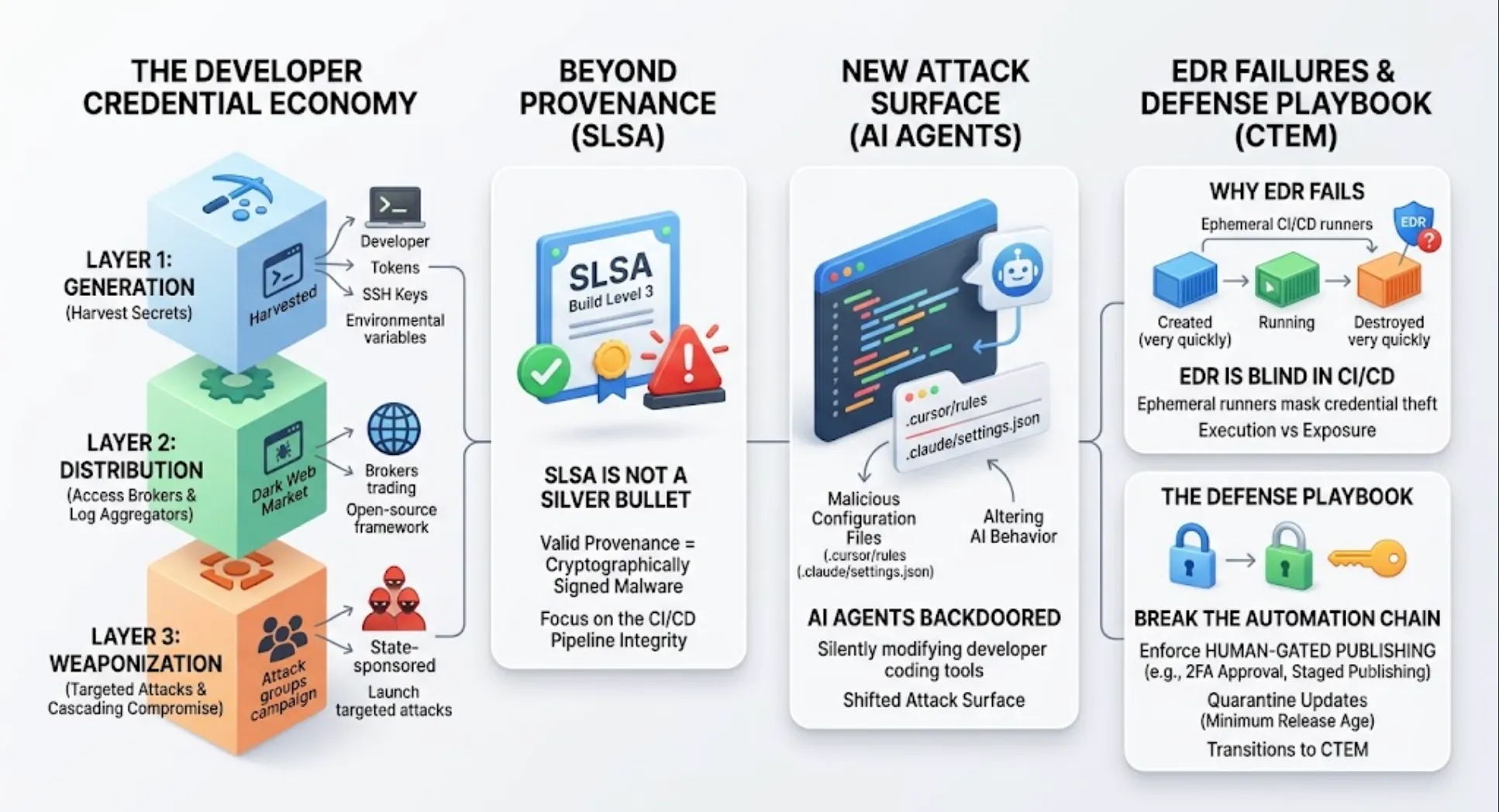
The Developer Credential Economy
Modern supply chain attacks are not orchestrated by a single monolithic APT. They operate as a structured, three-layer economy.
1. Layer 1: Credential Generation
Threat actors (like TeamPCP) compromise developer tools explicitly to harvest the credentials inside them. When Miasma infected a machine, it didn’t just deploy ransomware. It aggressively swept the environment for GitHub tokens, AWS/GCP credentials, HashiCorp Vault tokens, .env files, and SSH keys. Every developer who ran npm install became a credential generation node.
2. Layer 2: Distribution
Stolen developer credentials flow into infostealer log aggregators. The seven-week dwell time of the Red Hat cookie proves that access brokering is the critical link. Furthermore, the tooling itself is distributed. On May 12, TeamPCP open-sourced the “Mini Shai-Hulud” worm framework, lowering the barrier to entry and creating an ecosystem of copycat operators.
3. Layer 3: Weaponization
Downstream actors purchase these credentials to launch highly targeted attacks. A single credential pool might feed a state-sponsored North Korean exfiltration campaign (Sapphire Sleet) and a financially motivated extortion crew (LAPSUS$) simultaneously.
Beyond Provenance: The SLSA Level 3 Bypass
One of the most alarming evolutions in the Miasma campaign was its cryptographic validity.
The malicious Red Hat packages carried valid SLSA Build Level 3 provenance attestations the industry’s highest standard for supply chain integrity. How? The attackers didn’t steal a static npm token. They injected malware into Red Hat’s legitimate GitHub Actions workflow. The pipeline requested a short-lived OpenID Connect (OIDC) token and built the package.
The cryptographic certificate was accurate: the package was built by the legitimate pipeline. The pipeline just happened to be poisoned.
Lesson Learned: Provenance verification answers who built the software, not whether the software is safe. Organizations that treat SLSA as a silver bullet are ignoring the integrity of the CI/CD runner itself.
The AI Coding Agent Attack Surface
By Wave 3 of the Miasma campaign (June 5), the attackers introduced a profound escalation.
Security teams had quickly deployed monitoring for preinstall and postinstall npm scripts to catch the worm. In response, the attackers abandoned package installation entirely. Using compromised contributor accounts, they pushed malicious commits directly to repositories.
These commits didn’t alter application source code. Instead, they dropped hidden configuration files targeting AI coding assistants:
- Claude Code:
.claude/settings.json - Cursor IDE:
.cursor/rules - Gemini CLI: Configuration files for Gemini CLI
These instruction-layer overrides silently alter the behavior of the AI assistant the next time a developer opens the project. The attacker can subtly influence AI-generated code, introducing logic flaws or backdoors that appear as legitimate LLM suggestions. This shifts the attack surface directly from the package registry to the developer’s local AI-assisted workflow.
Why EDR Fails in Ephemeral CI/CD
If your defense strategy relies on Endpoint Detection and Response (EDR) catching the payload, you have already lost.
EDR monitors execution on persistent hosts. It has zero visibility into ephemeral CI/CD runners. When a GitHub Action spins up an Ubuntu container, runs a compromised npm install, exfiltrates your cloud secrets, and tears down two minutes later, your EDR sees nothing.
By the time an EDR agent fires on a developer’s laptop, the credential theft enabling the next wave of the attack has already happened. The detection evasion cycle is moving too fast; the “Phantom Gyp” wave bypassed script monitoring by using a 157-byte binding.gyp file to trigger execution. EDR is treating the symptom, not the disease.
The CTEM Playbook: Breaking the Automation Chain
To survive the Developer Credential Economy, organizations must transition from reactive execution-layer detection to preemptive Continuous Threat Exposure Management (CTEM).
Phase 1: Harden the Generation Layer
- Audit Lifecycle Hooks: Use
--ignore-scriptsuniversally for package installations. Monitor repository intake for malicious patterns. Disable automaticpreinstallscript execution. - Vulnerability Detection: Implement SCA scanners that analyze dynamic dependency trees, not just static manifests.
Phase 2: Hardening the CI/CD Pipeline
- Isolate Build Runners: Run all build workflows inside network-restricted, ephemeral sandboxes.
- Leverage OIDC Properly: Transition from long-lived PATs to OIDC federated identities, and restrict trust policies to specific branches.
Phase 3: Enforce Human-Gated Publishing
- Break the Worm: Self-propagating malware relies on automated publishing. Implement npm staged publishing (npm CLI 11.15.0+), which requires a human 2FA approval gate before any package version goes live.
- Quarantine Updates: Implement a
minimumReleaseAgepolicy. Never pull a package version that is less than 72 hours old in a production build pipeline.
Conclusion
Supply chain attacks are no longer opportunistic. They are an industrialized market designed to harvest, distribute, and weaponize developer credentials at scale. The open-sourcing of the Shai-Hulud worm framework guarantees that Miasma is just the baseline for what we will face in the second half of 2026.
Defenders must stop treating developer environments as trusted workstations and start treating them as highly targeted control-plane infrastructure.
To further enhance your cloud security and implement Zero Trust, contact me on LinkedIn Profile or [email protected].
Frequently Asked Questions (FAQ)
What is the Developer Credential Economy?
It is a three-layer underground market where threat actors use supply chain attacks to harvest developer credentials (Generation), sell them via infostealer logs (Distribution), and use them to launch cascading compromises (Weaponization).
How did the Miasma worm bypass SLSA Build Level 3?
Instead of stealing a static token, attackers injected malware directly into a legitimate GitHub Actions pipeline. The pipeline built the malicious package and signed it using trusted OIDC tokens, resulting in a cryptographically valid but poisoned package.
How are attackers targeting AI coding assistants?
Attackers are pushing malicious configuration files (like .cursor/rules or .claude/settings.json) into repositories. When a developer opens the project, the AI assistant's behavior is silently altered to generate vulnerable code or backdoors.
Why is EDR ineffective against modern supply chain attacks?
EDR monitors persistent endpoints but lacks visibility into ephemeral CI/CD runners. By the time EDR detects a malicious payload on a laptop, the credential theft inside the CI/CD pipeline has already occurred.
What is 'Phantom Gyp'?
Phantom Gyp is an evasion technique where attackers abuse the binding.gyp file to trigger malicious code execution during 'npm install', successfully bypassing security tools designed only to monitor 'preinstall' and 'postinstall' scripts.
